
- Lightweight
- Compact size
- Versatile
- Customisable
- Made in EU

Passive RF Sensor
PASSIVE RF DETECTION & UAV SIGINT
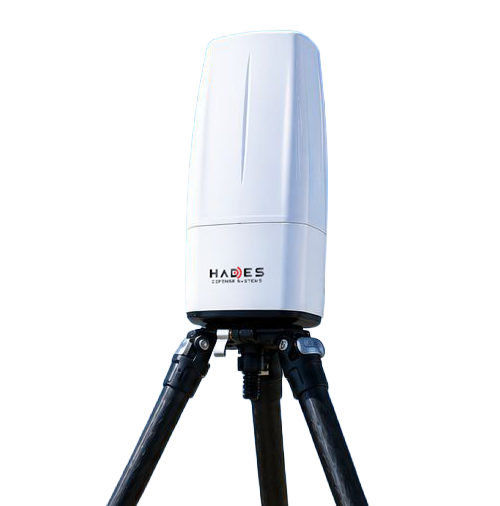
The HADES passive RF sensor is a passive electronic support sensor for RF detection, UAV SIGINT, and integrated Counter-UAS operations. The system operates without transmitting any signal, continuously monitoring the RF spectrum, maintaining a fully passive low-signature profile.
This enables deployment in tactical environments, for the protection of critical infrastructure, in border surveillance, and in airspace security operations where discrete detection capabilities are required. Because the sensor itself does not transmit anything, it can detect threats without revealing its own position, an operational advantage that active radar systems do not offer.
Passive RF sensor for Counter-UAS and drone detection
In a Counter-UAS role, the passive RF sensor detects, classifies and analyses command-and-control links, telemetry transmissions and video data links from both commercial and military unmanned systems. By correlating detected RF activity with known communication profiles and transmitter characteristics, the system supports rapid identification, threat assessment and operational decision-making. The sensor can perceive a drone based on its transmissions before the aircraft comes within range of active sensors or effectors.
Operational architecture
The passive RF sensor can function autonomously as an independent detection node or as part of a wider surveillance network. Multiple sensors can operate as a distributed network to extend RF coverage and, via triangulation of emitter positions, enhance situational awareness over large operational areas.
Within HDS FUSION, the passive RF sensor contributes to distributed sensor fusion and a common operational picture by correlating RF detections with radar tracks, EO/IR observations, and external sensor input. Thus, the sensor forms the passive detection layer that complements the portfolio's active radars: the RF sensor signals silently, after which radar or EO/IR can confirm the observation.
Commitment & integration
The compact and lightweight design allows for deployment on fixed installations, mobile platforms, telecommunications infrastructure and distributed multi-node surveillance networks. Built to an open architecture philosophy, the passive RF sensor integrates with third-party sensors, command and control environments, and national or NATO-compliant operational networks via standard APIs and communication interfaces.
Wideband Awareness in One Device
Detects all major RF and drone emitters across 0-6 GHz with instant precision.
Technical specifications
The sensor detects, classifies, and analyses command-and-control links, telemetry links, and video data links originating from both commercial and military UAV platforms.
The model shown supports wideband RF awareness within the 0–6 GHz frequency range (customisable up to 100 GHz), combining high sensitivity with real-time RF detection capabilities within a single compact operational platform.
By utilising emitter and protocol libraries, detected RF signatures can be correlated with known communication profiles, waveform behaviour and emitter characteristics to support rapid identification, threat analysis and operational decision-making.

Tactical added value
Simultaneous radar and RF detections can indicate actively controlled platforms, while radar tracks without RF activity may point to autonomous, pre-programmed, or emission-controlled threats. This provides operators with additional tactical context for threat analysis, prioritisation, and engagement assessment.
Operational architecture
The HADES Passive RF Sensor can operate fully autonomously with embedded local processing and detection capabilities, enabling standalone deployment as an independent operational sensor node.
As part of the HADES C4ISR Platform, the system contributes to distributed sensor fusion, RF-based situational awareness and an integrated Common Operational Picture (COP).
When integrated with radar, EO/IR, and external command and control systems, the sensor supports real-time correlation between RF detections, radar tracks, and optical observations.
Multiple sensors can be linked within a single operational architecture to significantly enhance RF coverage, situational awareness and geolocation accuracy over large areas.
Thanks to the software-defined architecture, expandable emitter libraries, and flexible backend environment, the sensor can be adapted to new UAV platforms, emerging communication protocols, and mission-specific operational requirements.
Stake configurations
The scalable deployment architecture supports:
- Fixed installations
- Mobile platforms
- Telecommunications mast infrastructure
- Distributed multi-node RF networks
- Border and coastal surveillance environments
Integration & interfaces
Via open interfaces and API-based architectures, the system can seamlessly integrate within existing third-party operational environments, including Counter-UAS architectures, sensor fusion platforms, command environments, and national or NATO operational networks.
The system supports real-time visualisation of detected emitters, RF events and correlated sensor tracks within a single integrated operational environment.
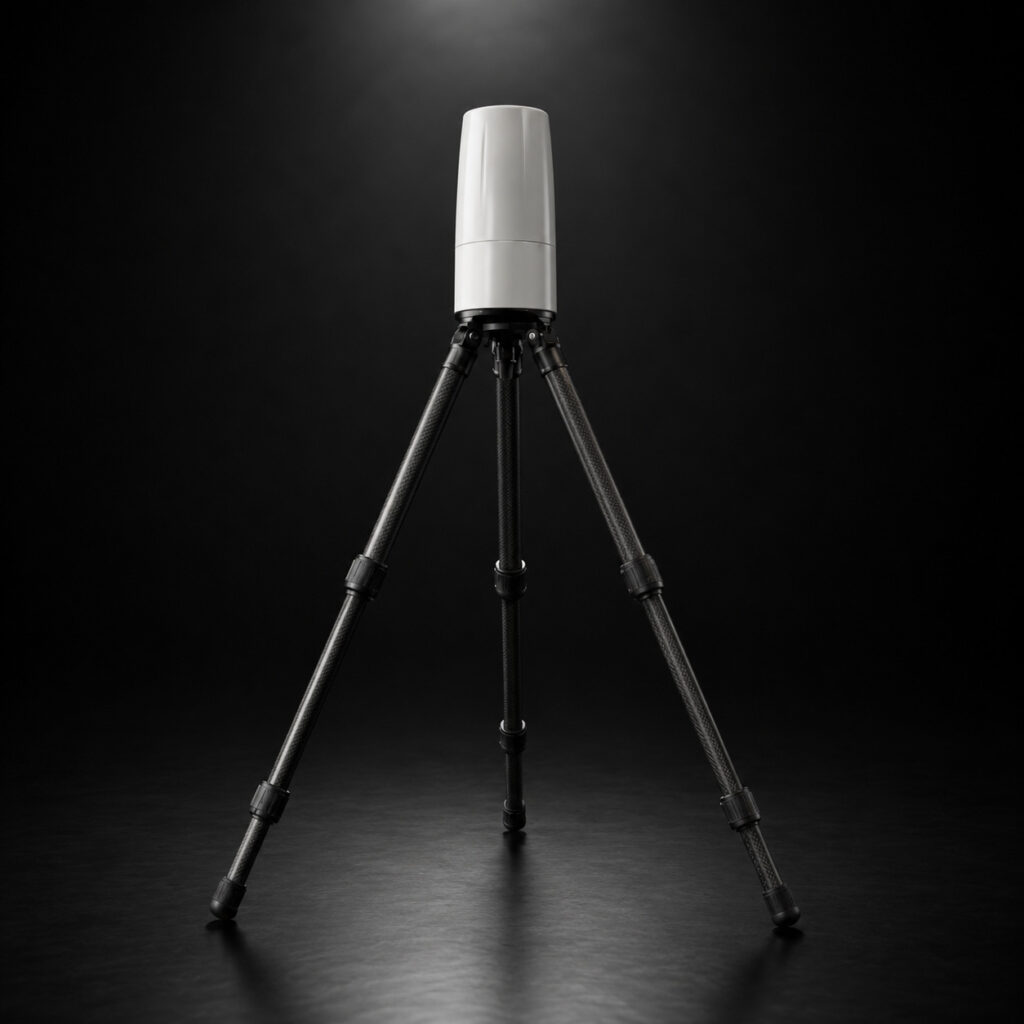
The sensor and specifications shown serve as examples from our standard portfolio. Each solution is fully custom configured by HADES based on your project and mission requirements.